
Finishing a job on site doesn’t always mean the work is finished from an administrative point of view.
A contractor may complete an installation, repair or inspection successfully. However, days or weeks later, someone may ask a simple question: Can you prove exactly what was completed?
Without a clear record, answering that question can mean searching through emails, photographs, paper forms and messages from field staff.
A structured work completion report provides a much clearer answer.
What is proof of work completion?
Proof of work completion is a record showing what work was carried out, where it took place, when it was completed and, where appropriate, who accepted it.
The exact evidence required depends on the job. A useful completion record could include:
- Date and time of completion.
- Site or customer details.
- Description of work completed.
- Photographs taken on site.
- GPS location.
- Details of defects or outstanding work.
- Engineer or contractor information.
- Customer comments.
- Client sign off and digital signature.
- A completed report that can be stored or shared.
Together, these details provide a much stronger record than simply marking a job as "complete".
Why can proving completed work become difficult?
The problem is often not that evidence was never collected. It is that the evidence is scattered across different places.
A site worker might take photographs on their phone. Notes could be written on paper. The customer might sign another document, while job details are held in an office system.
If a question arises later, somebody has to bring everything together.
This becomes particularly difficult when teams complete multiple jobs every day. Staff may not remember the exact circumstances surrounding a particular visit several months later.
A consistent work completion form helps capture the necessary information while the details are still fresh.
What should a work completion report show?
A good work completion report should make it possible for someone who was not present on site to understand what happened.
That means recording more than a simple completion status.
For example, imagine a window installation company replacing six windows at a property. Recording "installation complete" confirms very little.
A better record could show the property details, arrival and completion times, photographs of the installed windows, notes about the work and the customer's signature.
If a question is raised later about one of those windows, there is a clear record to review.
How do photographs help prove work was completed?
Photographs are particularly useful because they provide visual evidence of the condition of a site or asset at a specific stage of the job.
Teams can capture images before work begins, during the job and after completion.
This can help document:
- The original condition of the site.
- Workflow in progress.
- Installed equipment or materials.
- Repairs that have been carried out.
- Identified defects.
- The final condition before leaving the site.
Photos become even more useful when they are stored directly alongside the relevant job completion form rather than separately on an employee's phone.
A clear photo record can also provide useful context if work is questioned later.

Can GPS and timestamps provide additional evidence?
Yes. Location and time information can add useful context to a completion record.
GPS data can help identify where information was collected, while timestamps can show when the record was created.
This can be particularly useful for organisations with teams visiting multiple customer locations, construction sites or assets throughout the day.
Rather than relying solely on a written statement, the organisation has additional information connected to the site visit.
Why is client sign off important?
For some jobs, the strongest completion record includes confirmation from the customer or client.
A digital signature can confirm that a representative was present and acknowledged the work at that stage.
The form might ask the client to confirm that:
- The agreed work has been completed.
- The site has been inspected.
- Any outstanding items have been recorded.
- Relevant equipment or documentation has been handed over.
This does not necessarily mean there can never be a later dispute. However, client sign off creates a much clearer record of what was agreed at the point of completion.
What happens when work is only partly completed?
A completion process should not force workers to record unfinished work as complete.
Sometimes a team reaches the end of a site visit but still has outstanding items. A component might be unavailable, another contractor may need to finish related work, or a defect may require a return visit.
The record should clearly distinguish between:
Completed work: Items that have been finished and checked.
Outstanding work: Items requiring further attention, including notes, photographs and responsibility where relevant.
This makes the record more accurate and reduces confusion when someone returns to the job.
How can mobile forms improve completion records?
Paper forms can capture much of this information, but they create additional administration.
Information may need to be retyped. Photographs have to be matched with the correct project. Documents can be misplaced, and reports may not reach the office until much later.
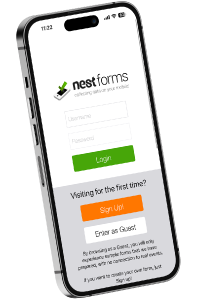
A mobile form app such as NestForms allows field teams to capture the completion information within a structured digital form.
Depending on the workflow, responders can record photographs, GPS information, notes, signatures and other job details directly on their mobile device.
Where connectivity is unreliable, forms can also be completed offline and synchronised when a connection becomes available.
This gives the office a consistent record without requiring field teams to recreate their notes after leaving the site.
When should completion evidence be collected?
The best time is usually before the person completing the work leaves the site.
Waiting until later creates opportunities for details to be forgotten or evidence to be missed.
A simple process might require the field worker to:
- Check the agreed work.
- Record any outstanding items.
- Take the required completion photographs.
- Confirm the site or asset details.
- Capture client sign off where required.
- Submit the completed form.
Making these steps part of the normal site workflow creates a repeatable process across the team.
How does a standard process help with disputes?
When a customer questions completed work, the first requirement is usually information.
What was agreed? What was completed? What did the site look like? Was a defect already present? Did somebody approve the work?
If each job has been documented differently, answering these questions can take considerable time.
A standard work completion report provides one place to start.
The organisation can review the recorded answers, photographs, dates, location information and signatures instead of relying entirely on memory.
This can also help managers identify whether the issue concerns the original work, an outstanding item or something that happened after completion.
Who benefits from better proof of completion?
Completion records are useful across many types of field work.
Construction teams can document completed project stages and snagging work. Installers can record equipment or materials fitted at a customer's property. Maintenance teams can show repairs carried out on an asset.
Surveyors, inspectors and field service businesses can also use structured records to demonstrate what happened during individual site visits.
The principle is the same: capture the evidence when the work happens rather than trying to reconstruct it afterwards.
Build proof into the completion process
Proving work was completed should not require an investigation every time a question is raised.
A structured job completion form can make evidence collection part of the job itself.
By combining site details, photographs, timestamps, GPS information, outstanding items and client sign off, businesses can create a reliable record of each completed visit.
NestForms allows organisations to build mobile completion forms around their own workflows, including forms for inspections, installations, snagging, handovers and project completion.
Teams can collect the required evidence on site and create consistent records that are easier to review, share and retain.
At NestForms we offer a free Training Demo as an introduction to the platform if you need it. For larger operations we also provide more detailed Assisted Onboarding.
Start your NestForms journey today and sign up for the free two week trial. You can review and test all of the features available to Premium plan users during this period.